
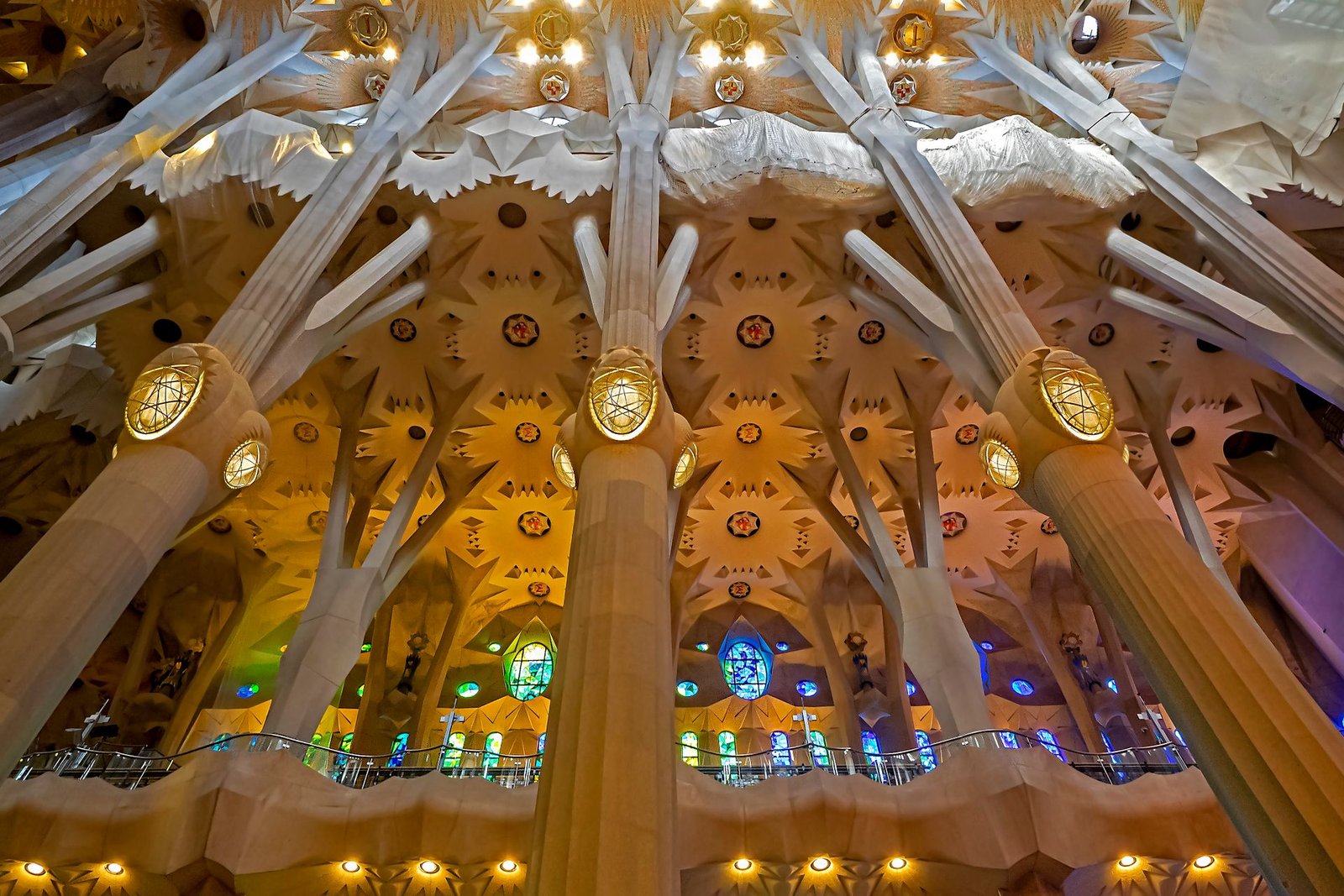
Stepping inside the Sagrada Família is the moment most visitors remember long after leaving Barcelona. While the exterior is instantly recognisable, the interior reveals a completely different experience
Official Tickets
Sunlight pours through enormous stained-glass windows, towering stone columns rise like the trunks of giant trees and every detail has been designed to combine architecture, faith and nature in a way unlike any other church in the world.
Many people spend weeks deciding whether to visit the basilica, but very few regret walking through its doors. Understanding what you can see inside the Sagrada Família before you arrive helps you appreciate details that might otherwise go unnoticed. The changing light, symbolic sculptures and remarkable engineering all become part of the experience rather than simply something to admire from a distance.
Throughout the day the atmosphere also changes. The colourful interior looks different during the morning than it does in the afternoon. The constantly changing light is one of the reasons why no two visits ever feel exactly the same.
Unlike many famous landmarks, the Sagrada Família is not simply a monument to admire for a few minutes. Most visitors spend much longer inside than they originally expected. Between the vast nave, museum, architectural details and optional tower visit, it is easy to lose track of time, making how long it takes to visit the Sagrada Família another useful part of your planning.
What Is Inside the Sagrada Família?
The moment the entrance doors close behind you, the sounds of Barcelona begin to fade. Instead of busy streets and traffic, you find yourself surrounded by a remarkable space filled with colour, light and silence. Although thousands of people may be visiting at the same time, the enormous scale of the basilica creates a surprisingly peaceful atmosphere.
Unlike many historic churches, the Sagrada Família does not rely on paintings, gilded decorations or elaborate marble interiors to create an impression. Instead, Antoni Gaudí designed the entire building around natural forms. Massive columns branch towards the ceiling like trees, while light filters through coloured glass to create the feeling of standing in a forest rather than a traditional cathedral.
Every part of the interior was designed to tell a story. The architecture reflects themes from Christianity, but also incorporates mathematics, geometry, botany and the natural world. Looking closely reveals countless details that many visitors miss on their first walk through the basilica. This is one of the reasons why many travellers choose to visit the Sagrada Família without a tour, allowing themselves the freedom to stop whenever a particular detail captures their attention.
Although the basilica remains an active place of worship, it is also one of the world’s most extraordinary architectural achievements. Experiencing the interior for yourself quickly explains why the Sagrada Família is famous, as every part of the building combines architecture, symbolism and extraordinary engineering.
What Makes the Interior So Unique?
Many famous churches impress visitors through their age or historical importance. The Sagrada Família creates its impact in a completely different way. Rather than looking backwards, the interior still feels remarkably modern despite construction having started in the nineteenth century.
One of the first things visitors notice is the absence of straight lines. Gaudí believed that nature rarely works in perfect symmetry, so he avoided rigid geometry wherever possible. Columns lean slightly as they rise, branching naturally into smaller supports before connecting with the ceiling high above. The result feels organic, almost as though the building has grown instead of being constructed.
Natural light is equally important. Throughout the day, sunlight moves through the stained-glass windows, transforming the appearance of the entire basilica. Cooler blues and greens dominate one side during certain hours, while warmer reds, oranges and yellows gradually illuminate the opposite side. Because of this constant movement, no two visits look exactly the same making the best time of day to visit the Sagrada Família an important consideration for anyone interested in photography or architecture.
The sense of height also surprises many visitors. From the outside, it can be difficult to appreciate just how enormous the interior really is. Standing beneath the soaring ceiling gives you a much better understanding of the building’s extraordinary height, while also revealing how carefully every structural element contributes to the overall design.
Official Tickets
The Forest of Stone Columns
Perhaps the most iconic feature inside the Sagrada Família is the forest of stone columns stretching across the nave. Instead of using traditional pillars, Gaudí created columns that divide into smaller branches as they rise, supporting the ceiling in much the same way that trees support a forest canopy.
The effect is immediate. Rather than feeling enclosed by heavy stone, visitors experience an open, airy space where the eye is naturally drawn upwards. Different types of stone were selected depending on the weight each column needed to support, allowing the structure to become both beautiful and remarkably efficient.
Walking slowly through this forest of columns reveals subtle differences from one area to another. Some columns appear almost perfectly smooth, while others display delicate textures that become more visible as the light changes. Looking upwards, the branching supports merge into geometric shapes that seem almost impossible to create from stone alone.
Many visitors instinctively stop in the centre of the nave to look straight up. It is one of those rare moments where photographs struggle to capture the true scale of what you are seeing. Even visitors who expected an impressive church interior are often surprised by just how immersive the experience feels once they are standing beneath the towering columns.
The remarkable engineering behind these structures also explains why construction has taken so many decades. Every column serves both an artistic and structural purpose, reflecting Gaudí’s extraordinary vision and the complexity of the basilica’s design.
The Famous Stained-Glass Windows
For many visitors, the stained-glass windows are the most unforgettable part of the interior of the Sagrada Família. Their colours transform the interior throughout the day, creating an atmosphere that constantly changes as the sun moves across the sky. Even if you’ve seen countless photographs before your visit, experiencing the light in person is something entirely different.
Gaudí believed that light should become part of the architecture itself rather than simply illuminate it. Instead of filling the basilica with decorative paintings, he allowed coloured sunlight to shape the interior. The result is a space that feels alive, with soft blues and greens flowing across one side of the nave while warm oranges, reds and golds gradually appear on the other.
Because of this, no two visits are ever exactly alike. Because the colours change throughout the day, the best time to visit the Sagrada Família largely depends on the experience you’re hoping to have. Morning light creates a completely different atmosphere from late afternoon, and photographers often plan their visit around these subtle differences. If capturing the interior is high on your list, our article about taking photos inside the Sagrada Família explains the photography rules and offers practical tips for making the most of the available light.
Many visitors instinctively stop in the centre of the nave and simply watch the colours move across the floor and columns. It is one of those rare places where standing still for a few minutes becomes part of the experience.
Looking Up: The Ceiling and Vaults
Sooner or later, every visitor finds themselves looking upwards. The ceiling rises almost effortlessly above the forest of columns, creating an extraordinary sense of space that photographs rarely capture accurately.
Rather than using traditional Gothic vaults, Gaudí designed a ceiling that reflects patterns found in nature. Geometric shapes blend into branching structures, while carefully engineered supports distribute the enormous weight of the building. The result feels remarkably light despite the huge amount of stone above your head.
Standing directly beneath the central crossing gives you one of the best views inside the basilica. From here, the branching columns seem to disappear into a canopy of light, reinforcing the impression that the entire building has grown naturally instead of being constructed.
Looking upwards also gives you a better appreciation of the basilica’s remarkable height. While the towers dominate Barcelona’s skyline from outside, it is only once you stand beneath the soaring vaults that their true scale becomes apparent.
Official Tickets
The Main Altar and Apse
As you continue through the nave, your attention is gradually drawn towards the main altar. Although less colourful than the stained-glass windows, this area carries enormous symbolic importance and forms the spiritual heart of the basilica.
Suspended above the altar hangs an impressive crucifix beneath a richly decorated canopy. Unlike many traditional churches, the space feels surprisingly open, allowing visitors to appreciate both the religious significance and the architectural balance of the design.
Behind the altar lies the apse, where natural light, sculptural details and carefully chosen materials combine to create a quieter atmosphere. Many visitors spend less time here than in the central nave, yet it remains one of the most beautiful parts of the interior for those willing to slow down and look closely.
Even visitors with little religious background often spend longer here than expected, simply because the atmosphere encourages you to slow down and look more closely.
The Symbolism Hidden Throughout the Basilica
One of the reasons the inside of the Sagrada Família continues to fascinate visitors is the sheer amount of symbolism woven into almost every detail. Gaudí believed architecture should communicate ideas, and throughout the basilica those ideas are expressed through shapes, numbers, colours and natural forms.
Columns resemble trees because nature represented God’s creation. Light symbolises hope and life, while geometric patterns reflect the mathematical order found throughout the natural world. Even the smallest decorative details often have a deeper meaning that becomes apparent only after careful observation.
This is one reason why many visitors choose to spend longer inside than expected. Every time you look in a different direction, another detail seems to appear. Visitors who allow enough time are far more likely to slow down and appreciate these details instead of rushing through the basilica.
The symbolism also helps visitors understand what makes the basilica unlike any other church in the world. Rather than creating a traditional church, Gaudí designed an immersive experience where architecture, engineering, faith and nature all work together to tell a single story.
The Museum Inside the Sagrada Família
Before leaving, many visitors continue to the museum beneath the basilica. While the spectacular interior naturally attracts most of the attention, the museum provides valuable context that makes the rest of the visit even more meaningful.
Original drawings, scale models and construction photographs reveal how Gaudí developed his ideas and how today’s architects continue building the basilica using modern technology. Seeing these models after walking through the church often helps visitors appreciate the extraordinary complexity of the project.
The museum also explains why construction has continued for so many decades. Rather than following a finished blueprint, today’s architects combine Gaudí’s surviving models with digital technology to complete a vision that began more than 140 years ago. Seeing these original models and construction methods makes it much easier to understand why the Sagrada Família is still under construction.
Most people spend between 20 and 40 minutes exploring the museum, although architecture enthusiasts often stay much longer. If you enjoy understanding how famous buildings are designed rather than simply admiring them, the museum is well worth including in your visit.
Official Tickets
Can You Visit the Towers?
For many visitors, exploring the basilica itself is the highlight of the experience. Others wonder whether they should also include the towers. The answer depends on what you hope to get from your visit.
The towers offer spectacular views across Barcelona and allow you to appreciate details of Gaudí’s architecture from a completely different perspective. At the same time, they are a separate experience from the main interior rather than an essential part of it. Many visitors leave feeling completely satisfied after exploring the basilica itself, while others consider climbing the towers the perfect finishing touch to their visit.
It is also worth remembering that tower access requires a specific ticket and is subject to availability. Whether you can climb the towers at the Sagrada Família depends on the ticket you choose and whether you’re comfortable with heights.
Accessibility Inside the Basilica
One of the most impressive aspects of the Sagrada Família is how accessible the main interior is for a wide range of visitors. Wide walkways, step-free routes and spacious viewing areas make it possible for most people to enjoy the basilica comfortably.
Visitors using wheelchairs or mobility aids can access the main parts of the basilica, museum and visitor facilities without significant barriers. Lifts are available where needed, although the towers are not accessible because of their narrow staircases and limited space. Anyone visiting the Sagrada Família in a wheelchair will benefit from planning ahead before arriving.
The spacious interior also makes the visit comfortable for older visitors who prefer to explore at a slower pace. Seating is available in several areas, allowing visitors to pause, admire the architecture and enjoy the changing light without feeling rushed. The spacious interior also makes visiting the Sagrada Família as a senior a comfortable experience, while the excellent accessibility at the Sagrada Família allows most visitors to explore the basilica at their own pace.
Visitor Facilities Inside the Sagrada Família
The Sagrada Família is designed to make longer visits comfortable. Beyond the basilica itself, visitors have access to practical facilities that allow them to spend more time enjoying the experience rather than worrying about logistics.
Accessible restrooms are available inside the visitor complex, making it easy to continue exploring without leaving the site. Knowing where to find the toilets in the Sagrada Família is especially useful if you’re visiting with children, older relatives or anyone who prefers to plan ahead.
There is also a gift shop where visitors can browse books, architectural models and souvenirs inspired by Gaudí’s work. Depending on your ticket, you may also pass through exhibition areas that provide additional insight into the ongoing construction of the basilica.
A little preparation can make the whole visit feel more relaxed. Knowing where to enter, what facilities are available and what to expect before you arrive means you can spend less time thinking about practical details and more time enjoying the architecture and atmosphere inside the basilica.
Official Tickets
Practical Tips Before Going Inside
A little preparation makes the experience inside the Sagrada Família much more enjoyable. Because entry works with timed slots, it is best to arrive early enough for security checks without feeling rushed. Once you are inside, the basilica rewards a slower pace, especially if you want to admire the stained glass, columns, museum and architectural details properly.
If you are travelling by car, arranging parking at the Sagrada Família before you arrive removes one of the biggest sources of stress on busy days. Public transport is often easier in central Barcelona, but having your arrival planned in advance helps you begin the visit more calmly.
Comfortable clothing also matters more than many visitors expect. Since the basilica remains an active place of worship, understanding the dress code for the Sagrada Família before you arrive helps avoid problems at the entrance.
Many visitors choose to visit the Sagrada Família without a tour, giving themselves complete freedom to explore at their own pace. Others prefer the additional historical context that a guide can provide, making the best choice largely a matter of personal preference.
Is It Worth Going Inside the Sagrada Família?
For anyone already standing outside, the answer is almost always yes.
The famous façades are remarkable in their own right, but they only tell part of the story. Walking inside reveals the full scale of Gaudí’s vision, where architecture, light, mathematics and nature combine to create one of the world’s most extraordinary interior spaces.
Even visitors who are not especially interested in architecture often describe the interior as one of the highlights of their time in Barcelona. The changing colours, peaceful atmosphere and remarkable sense of space make the basilica feel very different from almost any other church or monument.
Anyone wondering whether the Sagrada Família is worth visiting usually finds the answer within minutes of stepping inside, as the atmosphere is unlike anything the exterior can prepare you for.
Inside the Sagrada Família: Summary
Stepping inside the Sagrada Família is about far more than seeing the interior of a famous church. It is an opportunity to experience one of Antoni Gaudí’s greatest achievements exactly as he intended: a place where architecture, nature, light and spirituality come together in perfect harmony.
From the forest of stone columns and spectacular stained-glass windows to the museum, symbolic details and optional tower views, every part of the basilica offers something new to discover. Taking your time allows you to appreciate the countless details that make every visit unique.
Whether you are interested in photography, architecture, history or simply one of Barcelona’s most remarkable landmarks, the inside of the Sagrada Família is an experience that continues to surprise visitors long after they have left.
More to do in Barcelona
Still planning the rest of your visit? The Sagrada Família Visitor Guide brings together the practical information that helps you prepare, from accessibility and visitor facilities to parking, photography and what to expect during your visit. If you have a few last-minute questions before you go, you’ll also find quick answers on the frequently asked questions about the Sagrada Família.